
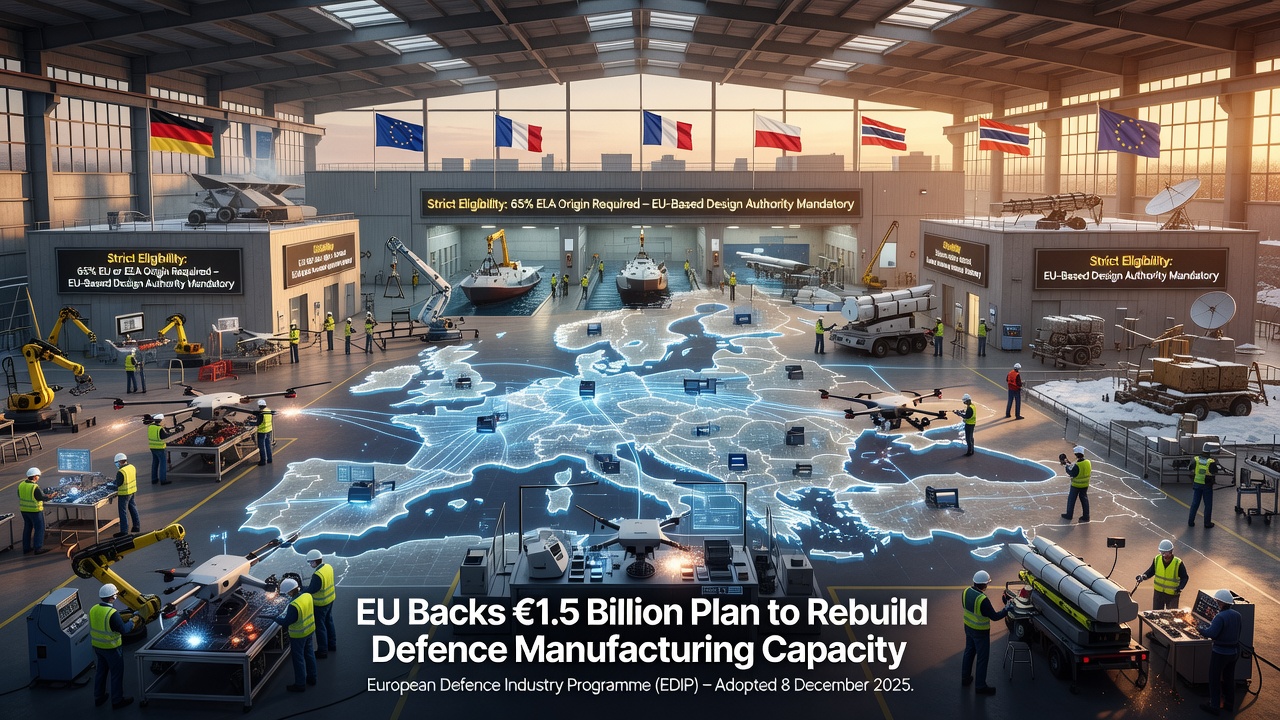
The Council adopted the European defence industry programme on 8 December 2025, putting €1.5 billion of EU grant funding behind an effort to rebuild manufacturing capacity across the bloc's defence sector. The money, drawn from the 2021-2027 multiannual financial framework, is meant to close gaps exposed by a shifting security environment and to push member states toward buying defence equipment together rather than separately.
Why Brussels Is Betting on Joint Procurement
For decades, European defence spending has been fragmented: dozens of national programmes, overlapping equipment types, and little economy of scale. EDIP tries to change that pattern by funding common procurement and long-term armaments cooperation between governments. The programme builds directly on two earlier instruments - EDIRPA, which supported joint purchasing, and ASAP, which focused on ammunition output - extending their logic into a broader industrial strategy. It also operationalises several proposals first set out in the European defence industrial strategy presented by the Commission and the High Representative in March 2024.
What the Programme Actually Funds
EDIP is not a single fund but a set of linked mechanisms. It establishes European defence projects of common interest, designed to build capabilities judged to matter for the whole bloc, including access to strategic domains such as space and seabed infrastructure. The Council approved the first five such projects on 28 September 2026, spanning:
- drones and counter-drone systems
- maritime and seabed defence
- space-based capabilities
- air and missile defence
- protection of Europe's eastern flank
Alongside these projects, EDIP creates the EU's first security-of-supply regime for defence products - a system intended to guarantee that components and finished equipment keep flowing to member states during a crisis, when export restrictions or supply shocks might otherwise interrupt production. A parallel European military sales mechanism will offer a centralised catalogue of defence products and the option to pool equipment for faster delivery, addressing a long-standing complaint that European forces lack a coordinated way to source and share hardware quickly.
Ukraine's Place in the Framework
A dedicated Ukraine support instrument, carved out of the total budget at €300 million, incentivises cooperative procurement with Ukrainian firms and funds the expansion of their manufacturing capacity. This reflects a broader shift in EU policy: treating Ukraine's defence industry not simply as a recipient of aid but as a partner integrated into European supply chains. The Council and Parliament have also asked the Commission to look at additional financing options beyond the current envelope, and the programme allows member states or third parties to contribute their own funds, suggesting the €1.5 billion figure is a floor rather than a ceiling.
Eligibility Rules and Strategic Autonomy
EDIP's funding conditions are as significant as its budget. Companies must be established in the EU with executive management based there, and must use EU-based infrastructure and assets to qualify. At least 65% of component costs in funded products must originate from the EU or European Economic Area countries, and design authority over a product must generally sit within the EU. The programme also bars sourcing components from non-associated countries whose interests conflict with EU security policy. Together these rules push the European defence industry toward self-sufficiency, reducing reliance on suppliers outside the bloc - a direct response to supply-chain vulnerabilities that became apparent in recent years of heightened geopolitical tension.