
A standard baccarat shoe takes roughly a minute per round. Speed baccarat cuts that to under thirty seconds, sometimes closer to twenty. That single change - the pace of play - does not alter the mathematics of the game, but it changes everything about how that mathematics affects your bankroll over a session. Players who treat speed baccarat like its slower cousin often walk away confused about why their losses accumulate faster despite betting the same amounts.
The confusion usually traces back to a misunderstanding of return to player, or RTP, and how it behaves differently when hand frequency triples. Understanding the baccarat RTP percentage on paper is one thing; understanding how that percentage translates into real losses per hour at high speed is another. Before adjusting any wager size or betting pattern, it helps to look closely at how a specific title handles its payout structure - reviewing something like speed baccarat a rtp gives a concrete reference point for how theoretical numbers show up in an actual game environment.
This piece breaks down the mechanics behind speed baccarat RTP, compares it against live baccarat RTP and standard online baccarat RTP rates, and lays out a baccarat speed strategy built for players who want to keep pace with faster tables without sacrificing control. The goal is practical clarity, not theory for its own sake.
Understanding Speed Baccarat and Its RTP Structure
What Makes Speed Baccarat Different From Standard Baccarat
Speed baccarat removes the ceremonial pauses of traditional play. Dealers deal faster, betting windows shrink, and the pause between the result of one hand and the start of the next is cut dramatically. The rules governing the third-card draw, the banker and player hand values, and the payout structure remain identical to classic baccarat. Nothing about the card logic changes - only the clock.
Why RTP Percentage Doesn't Change With Speed, But Exposure Does
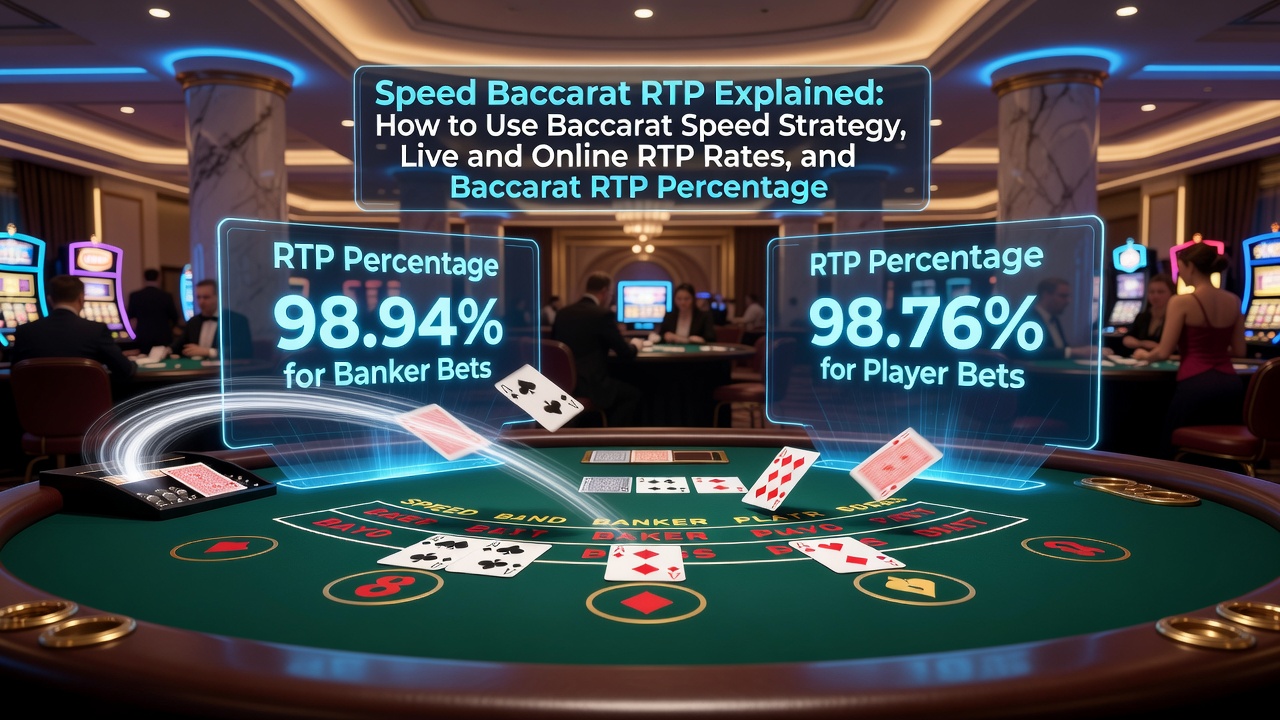
The baccarat RTP percentage is a fixed mathematical property of the bet type, not the table speed. A banker bet paying 0.95 to 1 with a five percent commission carries the same theoretical return whether you play ten hands an hour or thirty. What changes is exposure: more hands per hour means more decisions, which means the built-in house edge gets applied to your bankroll more frequently. Over a standard hour, a speed table might run through two or three times as many rounds as a traditional table, which compounds the effect of even a small negative edge.
The Three Core Bets and Their Typical Return Rates
- Banker bet: generally the lowest house edge of the three main options, typically just over one percent after commission is factored in.
- Player bet: slightly higher house edge than banker, usually a bit above one percent as well, but without a commission deduction.
- Tie bet: carries a substantially higher house edge, often in double digits, making it the least favorable of the standard wagers despite its attractive payout multiplier.
Live Baccarat RTP vs Online Baccarat RTP Rates
How Live Dealer Games Calculate Return to Player
Live baccarat RTP is derived from the same probability tables as any other baccarat variant, since a live dealer shuffling and dealing physical cards follows identical mathematical rules to a random number generator simulating a shoe. The difference lies in transparency and pacing. Live games run on human timing, which introduces natural variance in hands per hour, even in a "speed" format, because dealer consistency varies slightly from table to table.
How RNG-Based Online Titles Set Their Payout Percentages
Online baccarat RTP rates in RNG-driven versions are programmed directly into the game engine and tend to be more consistent from session to session than live tables, since there is no human pacing variable. These figures are typically published by the game provider and remain fixed unless the studio issues an update to the title itself.
Comparing the Two Formats Side by Side
Neither format inherently offers better returns; the RTP percentage is a function of the bet type and payout table, not whether a human or a machine deals the cards. The practical difference shows up in speed and atmosphere. RNG versions can be played at whatever pace the player sets, while live speed tables impose their own rhythm, which matters more for bankroll management than for the underlying odds.
How Game Speed Affects Real-World Returns
Hands Per Hour and Its Effect on Expected Loss
Expected loss is calculated by multiplying the house edge by total wagered amount across all hands played. A player at a standard table might complete forty hands an hour; the same player at a speed table might complete over a hundred. If the average bet size stays constant, total money wagered - and therefore total expected loss - rises in direct proportion to that increase in hand count.
Why Faster Play Requires Tighter Bankroll Discipline
A bankroll built for a leisurely two-hour session at standard pace can be depleted in under an hour at speed tables if bet sizing isn't adjusted downward. This isn't a flaw in the game; it's simple arithmetic. Treating a speed table with the same per-hand bet as a slow table effectively multiplies risk exposure without a corresponding increase in enjoyment or strategic control.
Session Length Planning for High-Frequency Tables
- Reduce per-hand bet size proportionally to the increase in hand frequency to keep hourly risk roughly constant.
- Set a hard stop-loss based on number of hands played rather than time elapsed, since speed tables compress time.
- Track results in blocks of twenty hands to get a clearer read on variance than a time-based check-in would provide.
Building a Practical Baccarat Speed Strategy
Adjusting Bet Sizing for High-Frequency Rounds
A sound baccarat speed strategy starts with recalculating unit size. If a player normally bets two percent of their bankroll per hand at a standard table, dropping to one percent or less at a speed table keeps total hourly exposure in a comparable range. This isn't about being more conservative for its own sake - it's about matching risk to the actual pace of decision-making.
Choosing Bets That Minimize House Edge at Speed Tables
Because faster play amplifies the effect of house edge, the case for sticking to banker and player bets becomes stronger, not weaker, at speed tables. The tie bet's higher edge, tolerable as an occasional side bet at a slow table, becomes far costlier when applied dozens of extra times per hour.
Managing Decision Speed Without Sacrificing Judgment
Speed tables shrink the betting window, which can push players toward impulsive decisions. A workable approach is pre-committing to a betting pattern before the session starts - for example, alternating or flat-betting on banker exclusively - so that no in-the-moment decision needs to be made under time pressure. This removes emotional drift from the equation entirely.
Recognizing When to Step Away
Because speed tables compress losses and wins into a shorter timeframe, emotional reactions intensify faster too. A pre-set loss limit, checked every twenty hands rather than every few minutes, gives a more accurate signal for when to stop than gut feeling does.
Reading and Verifying RTP Data Before You Play
Where Published RTP Figures Come From
Reputable game providers publish theoretical RTP figures based on the full mathematical model of the game, covering every possible outcome across the shoe. These figures are typically available in the game's information panel or a provider's technical documentation, rather than buried in marketing copy.
Spotting the Difference Between Theoretical and Session RTP
Theoretical RTP describes what happens over millions of hands. Session RTP - what a player actually experiences in an hour or two - can swing well above or below that figure due to normal variance. A game advertising a baccarat RTP percentage in the high 98s can still produce a losing session, and that outcome doesn't indicate anything is wrong with the game.
Questions to Ask Before Committing to a Table
- Is the published RTP figure specific to the banker, player, or tie bet, or is it a blended average?
- Does the platform disclose whether the figure applies to live or RNG versions specifically?
- Is commission on winning banker bets already factored into the stated percentage?
Frequently Asked Questions
Does playing speed baccarat lower my chances of winning compared to regular baccarat?
No, the odds per hand stay identical. What changes is how many times those odds get applied within an hour, which increases total exposure to the house edge rather than lowering your per-hand probability of winning.
Which bet has the best baccarat RTP percentage overall?
The banker bet typically offers the lowest house edge of the three standard options, even after the commission deduction on wins, making it the statistically strongest choice for players focused purely on long-term return.
Should I use a different bankroll strategy for speed tables versus standard tables?
Yes. Because speed tables run through significantly more hands per hour, reducing your per-hand bet size and setting hand-count-based stop-losses rather than time-based ones keeps your hourly risk in a comparable range to slower play.
Is live baccarat RTP generally better than RNG-based online baccarat RTP rates?
Not inherently. Both formats calculate RTP from the same underlying probability tables tied to the bet type, so the payout structure itself doesn't favor one format over the other - the practical differences lie in pacing and atmosphere, not returns.
Can a betting pattern improve my baccarat RTP percentage?
No betting pattern changes the mathematical RTP of a bet, since each hand is an independent event. Patterns can help with bankroll management and discipline, but they cannot alter the fixed house edge built into banker, player, or tie wagers.
How many hands should I track before judging whether a speed table is performing normally?
A sample of at least a few hundred hands is generally needed before results start to reflect the theoretical RTP with any reliability. Judging a table's fairness after only twenty or thirty hands at speed pace will mostly reflect normal short-term variance rather than any real deviation.