
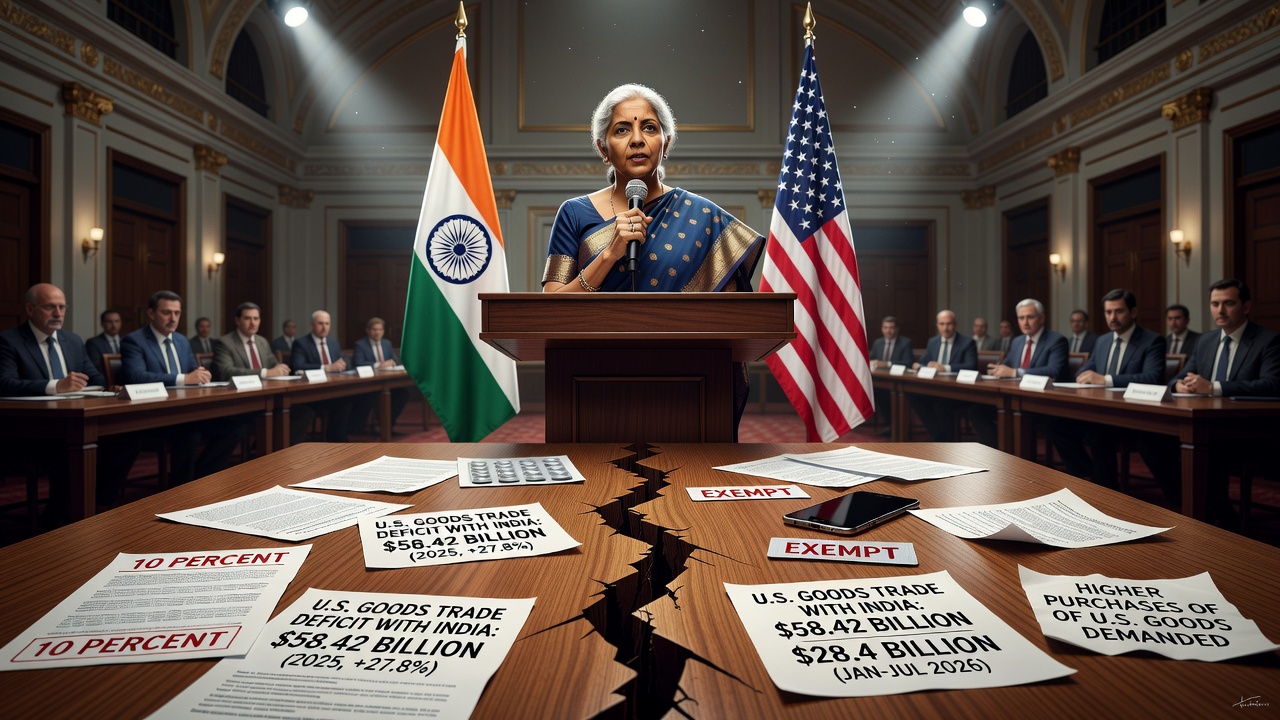
India's Finance Minister Nirmala Sitharaman delivered an unusually candid assessment of the stalled India-U.S. trade negotiations on Monday, telling reporters at the Munich Leaders Meeting in New Delhi that both sides may have reached a "plateau beyond which giving or taking might be very very difficult." It is the first time a senior Indian official has publicly conceded the depth of the impasse, a shift in tone that follows weeks of guarded optimism from both capitals.
A Deal Stuck on Numbers
The core disagreement, according to Sitharaman, centers on Washington's insistence on using the trade imbalance as the primary yardstick for concessions. The U.S. goods trade deficit with India stood at $58.42 billion in 2025, up 27.8% from the previous year, and had already reached $28.4 billion in the first seven months of 2026. Sitharaman questioned how far negotiators can realistically go when imbalance reduction becomes the "sole criteria," a framing that leaves little room for the kind of incremental trade-offs typical of bilateral agreements.
Her remarks echoed, almost in parallel, comments from U.S. Trade Representative Jamieson Greer last week, who said a deal was not "imminent." That two separate officials, on opposite sides of the table, used similarly deflating language within days of each other suggests the stalemate is not a matter of miscommunication but of genuinely divergent red lines.
Tariffs, Exemptions and What's at Stake
Indian exports to the U.S. currently face a 10% tariff, a rate tied to the conclusion of a USTR investigation into forced-labor practices across 60 countries. New Delhi notes that major export categories - generic pharmaceuticals and smartphones among them - fall outside this duty, offering some insulation. But the broader risk is structural: without a finalized agreement, India could end up facing steeper tariffs than competitor economies that do strike deals, undermining access to a market it depends on heavily.
- India is pushing for preferential tariff treatment to keep its exports price-competitive against rivals.
- The U.S. wants higher Indian purchases of American goods, part of what Sitharaman described as an effort to recoup losses accumulated over years of imbalance.
- An interim arrangement floated by President Trump in February referenced India agreeing to "buy American" at a higher volume, though full terms were never formalized.
Diplomatic Signals Without Resolution
Last week's call between Prime Minister Narendra Modi and President Trump touched on trade, defense, energy and critical technologies. Modi called the exchange "productive," Greer described it as "constructive," yet Trump himself offered no public comment - a silence that analysts reading the relationship closely have noted as telling in itself. Mark Linscott, a former assistant U.S. trade representative now advising the U.S.-India Strategic Partnership Forum, framed the stakes bluntly: both economies stand to lose if talks collapse entirely, since American exporters already face higher tariffs inside India, while Indian exporters risk losing competitive ground in the U.S. market if no agreement materializes.
Why This Matters Beyond Trade Ministries
For businesses on both sides - exporters, manufacturers, and the logistics and finance firms that serve them - prolonged uncertainty complicates planning cycles, pricing strategies and investment decisions. A plateau in negotiations does not necessarily mean collapse, but it does signal that the easy concessions have been made and what remains will require political will neither government has yet shown. How long that standoff lasts, and whether either side blinks first, will shape trade flows and corporate strategy well into the coming year.