
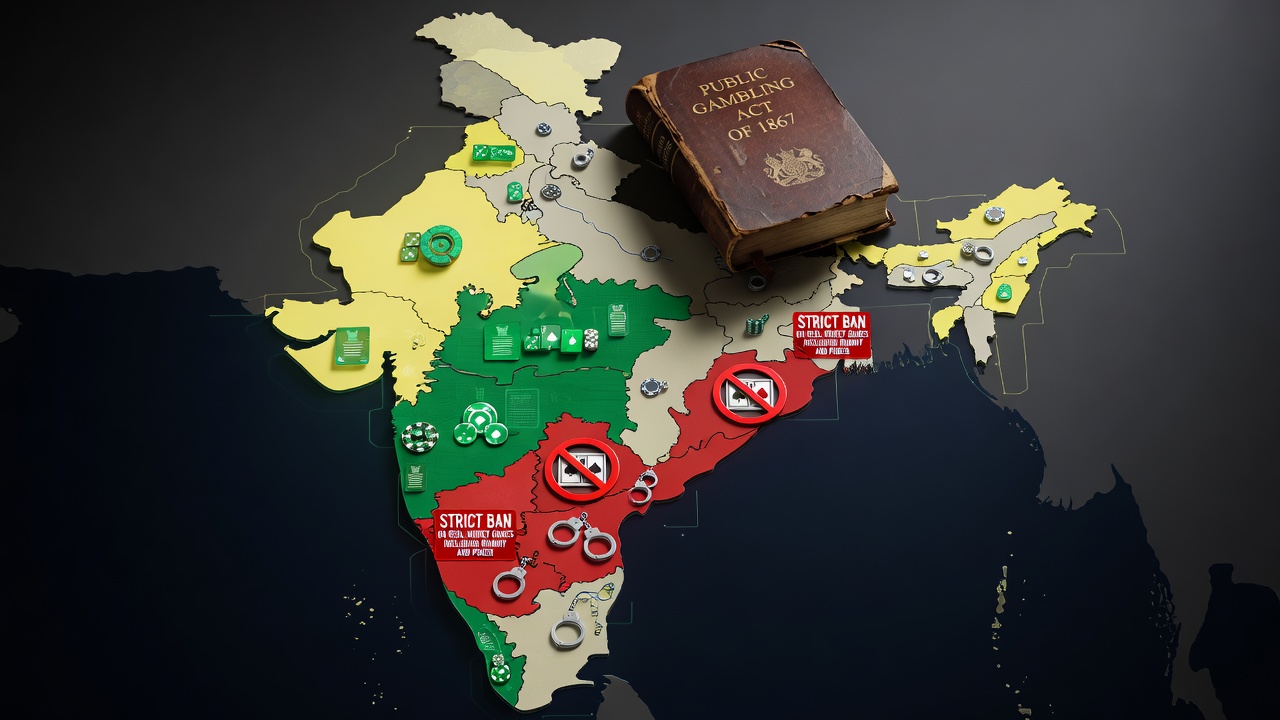
India has no single law that bans or permits online gambling nationwide. That single fact confuses more players, operators, and even lawyers than almost any other feature of the country's regulatory landscape. A 149-year-old colonial statute still shapes court rulings, while individual states write their own rules, sometimes contradicting each other within a few hundred kilometers.
This patchwork creates genuine confusion for anyone trying to figure out whether placing a bet from a phone in Mumbai carries the same legal weight as doing so from Goa or Sikkim. Courts have stepped in repeatedly to fill gaps left by outdated legislation, and their reasoning often hinges on a distinction between games of skill and games of chance - a line that sounds simple but gets messy fast when applied to poker, rummy, or fantasy sports. Understanding why online gambling is legal in india for some formats and restricted for others requires looking at both the historical statutes and the more recent judicial interpretations that have reshaped the industry.
What follows is a state-by-state, law-by-law breakdown of where things stand in 2024 - covering betting, online casinos, taxation, and what actually happens if a resident places a wager through an offshore platform.
The Legal Foundation: Historical Laws Governing Gambling in India
The Public Gambling Act of 1867
The Public Gambling Act, passed under British colonial rule, remains the backbone of gambling regulation in most Indian states. It criminalizes operating or visiting a "common gaming house," but it was drafted decades before telephones became common, let alone smartphones. The Act never mentions digital platforms, internet transactions, or remote betting, which leaves enormous interpretive space for courts and state legislatures. Several states have since amended or replaced this framework with their own gaming acts, while others still rely on the 1867 text almost verbatim.
Why This Old Law Still Matters for Digital Betting
Because the Constitution assigns "betting and gambling" to the State List rather than the Union List, each state has authority to legislate on the subject independently. This explains much of the confusion around online gambling legality in India: a practice permitted in one state might technically fall into a legal gray zone in another, even though the underlying activity - placing a bet through a website or app - looks identical to the user.
The Skill vs. Chance Distinction
Indian courts have consistently exempted "games of mere skill" from the definition of gambling. This principle, first articulated in cases involving rummy, has since been extended by various High Courts to cover poker and fantasy sports, provided the outcome depends predominantly on player skill rather than random chance. This distinction is the single most important legal concept for anyone assessing the legality of betting and gambling in India today.
Is Online Gambling Legal in India? The Current Legal Status
No Central Law Explicitly Bans Online Betting
There is no federal statute that makes online gambling a criminal offense across the entire country. The Information Technology Act, 2000, addresses cybercrime broadly but does not specifically criminalize online betting. This absence of a direct central prohibition is often cited as evidence that offshore betting sites can legally accept Indian customers, since no national law explicitly forbids the transaction itself.
State-Level Prohibitions and Permissions
Several states have taken direct action. Telangana, Andhra Pradesh, and Tamil Nadu have passed legislation banning online games involving stakes, including rummy and poker, following public concern over financial losses and addiction. Sikkim and Nagaland, by contrast, have created licensing frameworks that explicitly permit certain forms of online gaming and skill-based betting within their jurisdictions.
The Role of Offshore and International Operators
Millions of Indian users access gambling platforms licensed in Malta, Curaçao, or the United Kingdom. Because these operators are not physically based in India and do not require an Indian license to operate, they exist in a jurisdictional gap. Indian authorities have occasionally blocked specific domains, but enforcement against individual bettors using such platforms has been rare, largely because prosecuting an individual under the Public Gambling Act requires proving they visited a physical "gaming house" - a concept that doesn't translate cleanly to a mobile app.
- States with explicit online betting bans: Telangana, Andhra Pradesh, Tamil Nadu, Odisha, Assam, Nagaland (for certain formats), Sikkim (partial restrictions)
- States with licensing frameworks: Sikkim, Nagaland
- States with no specific online gambling legislation: most others, defaulting to older gaming acts or the 1867 framework
Indian Online Gambling Laws 2024: What Has Changed
The IT Rules Amendment and Online Gaming Regulation
In 2023, the Ministry of Electronics and Information Technology introduced amendments to the IT Rules specifically addressing online real-money games. These rules require designated self-regulatory bodies to verify that a game qualifies as one of skill before it can operate legally with real-money stakes. While the amendment primarily targets domestic gaming platforms rather than pure betting or casino products, it signals a broader governmental intent to formalize oversight rather than leave the sector entirely unregulated.
GST and Taxation Changes Affecting Betting Platforms
The Goods and Services Tax Council implemented a flat 28% tax on the full face value of bets placed on online gaming, casinos, and horse racing, effective from October 2023. This represented a significant shift from taxing only the platform's commission or gross gaming revenue. The change has pushed up costs for players on domestically licensed platforms and prompted debate over whether it inadvertently pushes users toward untaxed offshore sites.
Draft National Legislation Proposals
Discussions around a unified national framework for online gaming and betting have surfaced periodically, but no comprehensive central law has been enacted as of 2024. Industry bodies have lobbied for clearer, uniform rules, arguing that the current state-by-state approach creates compliance costs and legal uncertainty that discourage legitimate, taxpaying operators from entering the Indian market.
Online Casino Legality in India: Rules for Betting Platforms
Are Domestic Online Casinos Permitted?
No Indian state currently issues licenses for online casinos in the way Sikkim licenses certain sports betting and skill-gaming operations for offline, physical premises. Online casino legality in India, therefore, largely hinges on whether the operator is based abroad. Indian residents cannot legally operate a licensed online casino targeting domestic players under existing state frameworks.
Betting on Sports: Cricket, Football, and Beyond
Sports betting occupies a particularly murky space. Cricket, India's most popular sport, generates enormous betting volume through offshore platforms during major tournaments, yet no state has created a domestic licensing scheme for sports wagering comparable to what exists in the UK or parts of the US. Horse racing remains a notable exception - it has long been classified as a game of skill by Indian courts and is legally regulated in several states through licensed racecourses and totalisator systems.
Fantasy Sports as a Legal Gray Area
Fantasy sports platforms have won repeated court victories arguing that assembling a virtual team requires skill and knowledge rather than chance. The Punjab and Haryana High Court and the Bombay High Court have both upheld this classification, giving fantasy sports a firmer legal footing than casino games or straightforward sports betting, even though money changes hands based on real-world sporting outcomes.
Legality of Betting and Gambling in India: Regional Variations
Goa, Daman, and Sikkim: The Exceptions
Goa permits licensed physical casinos, primarily on offshore vessels along the Mandovi River, under the Goa, Daman and Diu Public Gambling Act. Sikkim has gone further by creating a legal framework for online gaming and betting through licensed operators, making it the closest thing India has to a regulated online gambling jurisdiction.
States With Strict Bans
Telangana enforces one of the strictest positions in the country, criminalizing online betting and rummy for stakes outright, with penalties including imprisonment. Andhra Pradesh and Tamil Nadu followed similar paths, though Tamil Nadu's ban faced legal challenges questioning its constitutionality regarding skill-based games.
What Determines Enforcement in Practice
Enforcement intensity varies enormously depending on local police priorities, political will, and whether a case involves a domestic operator versus an individual placing bets through a foreign app. Prosecutions against individual bettors remain uncommon, while enforcement actions more often target local agents, cash collection networks, or domestic websites operating without proper classification.
Practical Implications for Players in 2024
Using Offshore Betting Sites: Risks and Realities
Indian users who place bets through internationally licensed platforms generally face minimal direct legal risk, since prosecution under existing laws targets operators and physical premises rather than individual bettors using apps. That said, payment processing has become more complicated as banks and payment gateways increasingly flag transactions linked to gambling platforms, pushing many operators toward cryptocurrency or e-wallet alternatives.
Tax Obligations on Gambling Winnings
Winnings from gambling and betting, regardless of whether the platform is domestic or offshore, are taxable under Indian income tax law at a flat rate under Section 194B and related provisions. Players are technically required to declare such income, though enforcement of this obligation for individual winnings from offshore platforms remains inconsistent.
How to Assess Whether a Platform Operates Legally
Checking a platform's licensing jurisdiction, reading its terms regarding Indian users, and understanding which state framework might apply are reasonable first steps before depositing money. Platforms licensed in Sikkim or Nagaland, or those regulated by recognized international authorities, generally offer more transparency than unlicensed domestic sites operating in outright violation of state bans.
Frequently Asked Questions
Can I get arrested for online betting in India?
Individual prosecution for placing bets through an offshore app is rare because most existing laws target operators and physical gambling houses rather than individual users. States like Telangana and Andhra Pradesh have stricter enforcement, but even there, cases against individual bettors remain uncommon compared to actions against local operators.
Is playing poker for real money illegal in India?
Poker occupies a legal gray zone because several High Courts have classified it as a game of skill, exempting it from gambling prohibitions in certain states. However, Telangana, Andhra Pradesh, and a few other states have explicitly banned poker for stakes regardless of the skill argument, so the answer depends entirely on your state of residence.
Which Indian states allow online casinos legally?
Sikkim is the only state with a formal licensing framework permitting certain online gaming and betting operations. Goa allows physical casinos but has not extended licensing to online casino platforms. No other state currently issues licenses for online casino operations targeting domestic residents.
Do I have to pay tax on winnings from betting apps?
Yes, gambling and betting winnings are taxable under Indian income tax law, typically at a flat rate regardless of your total income slab. This applies whether the platform is domestic or based offshore, though enforcement for foreign platform winnings depends largely on voluntary disclosure.
Why does India not have one national law for online gambling?
Betting and gambling fall under the State List in the Indian Constitution, giving individual states authority to legislate independently rather than relying on a single central law. This constitutional division explains why rules differ so sharply between states like Sikkim and Telangana.
Are fantasy sports platforms like the ones used for cricket legal?
Multiple High Courts, including the Bombay High Court and Punjab and Haryana High Court, have ruled that fantasy sports qualify as games of skill rather than gambling. This gives them firmer legal standing than casino games or direct sports betting in most Indian states, though a few states have imposed restrictions regardless.