
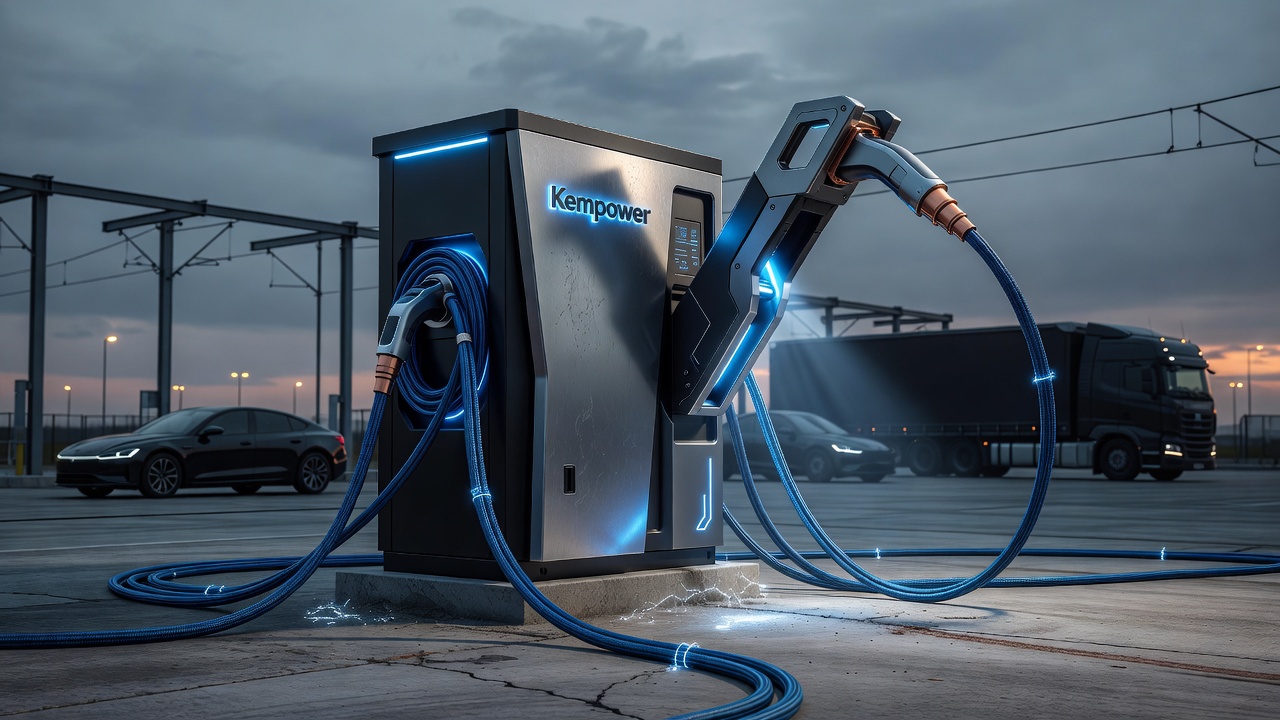
Kempower has introduced a charging unit designed to solve one of the most expensive problems in electric transport infrastructure: building separate systems for cars and heavy-duty trucks. The new Mega Satellite Flex supports both the established Combined Charging System, delivering up to 560 kW, and the emerging Megawatt Charging System, capable of pushing up to 1.2 MW into a truck's battery. It was unveiled this week at the company's Unplug & Recharge event, held alongside ACT Expo.
The timing reflects a broader industry inflection point. CCS has been the workhorse standard for passenger EVs for more than a decade, but it was never engineered for the power demands of long-haul electric trucks, which need to recharge massive battery packs in the time a driver takes for a mandated rest break. MCS was developed specifically to close that gap, and infrastructure operators are now weighing how quickly to invest in it without stranding capital on a technology that's still gaining adoption. Readers tracking the wider shift toward high-voltage charging networks and how that intersects with connectivity and fleet management systems can find more details on related infrastructure trends elsewhere.
One Site, Two Standards
The practical appeal of the Mega Satellite Flex lies in flexibility rather than raw power alone. Charging site operators have historically faced a binary choice: build for passenger vehicles or build for trucks, since the connectors, cabling, and power electronics differ substantially. Kempower's dispenser collapses that choice by letting a single unit serve either standard, which means a site developer can install infrastructure today and adjust its use as truck traffic grows, without a second construction phase.
That matters financially. Charging hardware is capital-intensive, and utilization rates determine how quickly an operator recovers that investment. A dispenser that can serve passenger EVs now and pivot toward MCS-capable trucks as that fleet expands keeps equipment earning revenue instead of sitting idle while waiting for one market segment to mature.
Technical Specifications and Compatibility
The unit is built to handle demanding electrical loads on both sides of the standard divide. Key specifications include:
- Up to 1,500 amps for MCS charging sessions
- Up to 700 amps for CCS sessions
- A 5-meter (16.4-foot) cable for CCS connections
- A 2.7-meter (8.86-foot) cable for MCS connections
- Optional integrated payment terminal
The Mega Satellite Flex also accommodates 800-volt EV architectures, an increasingly common design in newer passenger and commercial vehicles that allows for faster charging without proportionally higher current. Because the dispenser is compatible with Kempower's existing distributed charging architecture, operators already running Kempower equipment can add the new unit without redesigning their power distribution setup.
What Comes Next
Kempower plans to bring the Mega Satellite Flex to market in North America and Europe in July 2026, giving operators over a year to plan deployments. The rollout will test how quickly heavy-duty electric trucking scales relative to passenger EV adoption, and whether dual-standard hardware becomes the default approach for new charging sites or remains a transitional solution until MCS achieves the ubiquity that CCS enjoys today. Either way, the move signals that infrastructure providers are betting on convergence rather than parallel buildouts as the more economically sound path forward.