
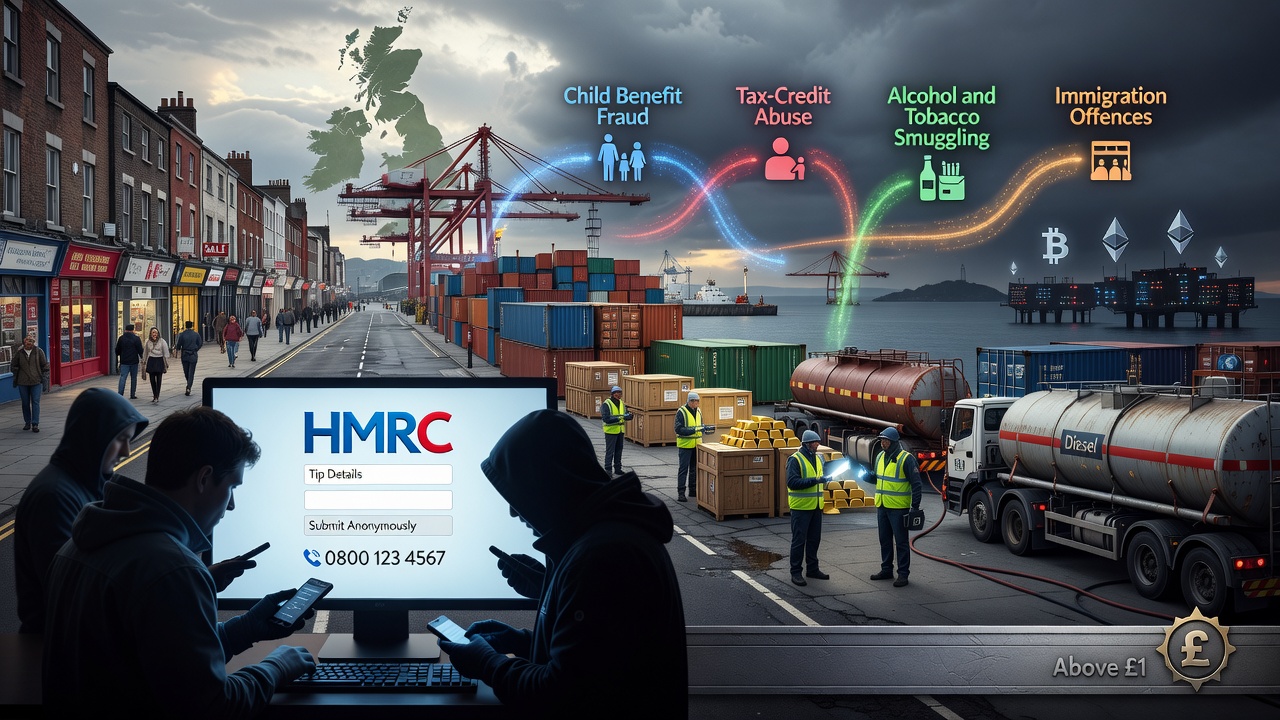
HM Revenue and Customs has consolidated the ways members of the public and businesses can flag suspected tax fraud, from underpaid corporation tax on the high street to smuggled fuel, hidden crypto assets and sanctioned goods moving through UK ports. The system relies heavily on public tip-offs, and HMRC has made clear that anonymity is protected throughout the process. For a tax authority that must police millions of businesses and individuals with finite investigative resources, these reports function as an early-warning network that no amount of internal auditing can fully replace.
What falls within scope
The reporting mechanism covers a broad spread of conduct: deliberate tax avoidance or evasion, Child Benefit and tax credit fraud, concealment of assets or cryptocurrency, and fraud tied to physical retail businesses. It also extends into areas that overlap with organised crime, including illicit trade in alcohol, tobacco and road fuel, the smuggling of precious metals, and the unlicensed import or export of goods, including those subject to international sanctions. This range reflects how tax fraud rarely exists in isolation. Fuel laundering, for instance, often sits alongside supply-chain fraud and organised distribution networks, which is why HMRC treats these disclosures as intelligence rather than isolated complaints.
Why a financial incentive exists
HMRC operates a reward scheme for information that leads to the recovery of more than £1.5 million in tax through serious avoidance or evasion cases. This threshold signals the scale HMRC is targeting through this particular channel: large, structured non-compliance rather than minor discrepancies. Rewards are discretionary and tied to outcomes, not simply to the act of reporting, which keeps the incentive aligned with genuine enforcement value rather than encouraging speculative or low-quality tips.
Boundaries of the service
Not every complaint belongs in this channel. Benefit fraud outside Child Benefit and tax credits, general crime, antisocial behaviour, immigration offences, identity theft and suspicious HMRC-branded emails or texts are all routed elsewhere. This separation matters operationally: tax fraud investigations require different evidence, legal powers and specialist units than, say, phishing scams impersonating HMRC. Keeping these streams distinct allows each to be triaged by the right team without one category of report drowning out another.
How the process is designed to protect informants
Reporters can remain fully anonymous, and any personal details voluntarily provided are kept confidential and used only if HMRC needs further clarification. The guidance is explicit that people should not attempt their own investigation or alert the person or business being reported. This is a standard safeguard in fraud reporting generally, reducing the risk of tipping off suspects, compromising an active investigation, or exposing the reporter to retaliation. Submissions are made through an online form or a dedicated phone line, with HMRC specifically asking that no supporting documents be sent unsolicited by post or webchat.
The broader compliance picture
Tax fraud reporting sits within a wider trend across regulated sectors, from financial services to online gambling, where authorities increasingly depend on structured public and industry tip-offs to supplement audits and automated data checks. As transactions move faster and assets become easier to disguise through crypto or offshore structures, tax authorities like HMRC are leaning more on distributed intelligence networks. For businesses, this raises the practical stakes of compliance: informal reporting channels mean that non-compliance is not only a matter of regulatory audit risk but also of exposure through customers, competitors, or employees.