
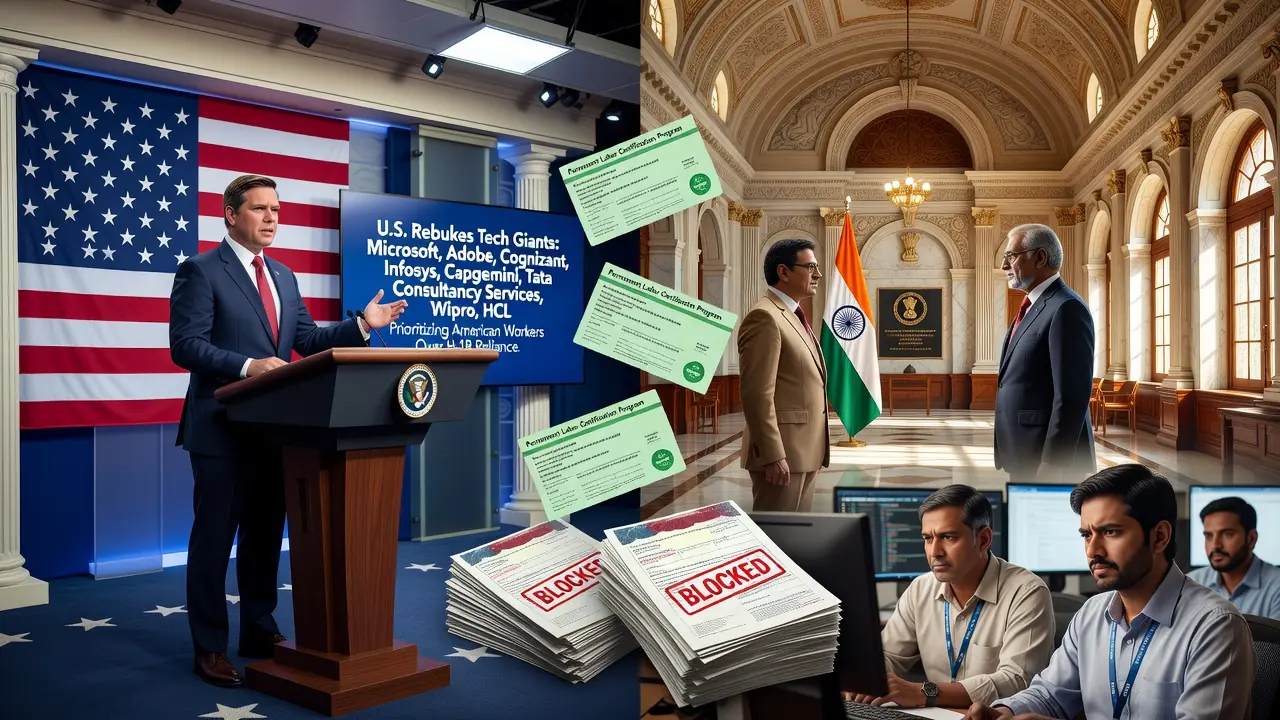
A diplomatic rift has opened between Washington and New Delhi after India's Ministry of External Affairs publicly condemned remarks by U.S. Vice President J.D. Vance concerning Indian professionals working in the United States. The dispute follows a U.S. Department of Labor decision to suspend Microsoft, Adobe and several of India's largest IT firms from a program that allows employers to sponsor H-1B visa holders for permanent residency.
What Triggered the Diplomatic Friction
Vance said the Trump administration expects companies operating in the U.S. to "employ American workers" and criticized firms for laying off domestic staff while retaining foreign workers on H-1B visas, whom he described using language India's foreign ministry called reminiscent of "colonial legacy connotations." He singled out Microsoft, accusing it of replacing 6,000 laid-off employees with H-1B holders. India's government responded sharply, calling the terminology "deeply offensive" and insisting that Indian professionals in the U.S. are "highly educated and skilled contributors" to American innovation.
The Mechanics of the Visa Suspension
The Permanent Labor Certification program is a step employers use to sponsor foreign workers for green cards. By suspending Microsoft, Adobe, Cognizant, Infosys, Capgemini, Tata Consultancy Services, Wipro and HCL from the program, the Labor Department has not revoked existing visas, but it has blocked a pathway these companies previously used to help H-1B employees transition toward permanent residency. India's foreign ministry was careful to note that current H-1B visa holders and their dependents are not affected in terms of status or validity. Still, the move signals a tightening of how the U.S. treats the pipeline linking temporary work visas to long-term settlement.
Why India Dominates the H-1B Conversation
Indian nationals accounted for roughly 70% of H-1B beneficiaries in 2025, according to official data, making any policy shift around the program disproportionately consequential for India's workforce and its technology sector. The H-1B visa has long served as a bridge connecting American demand for specialized technical labor with India's large pool of engineering and IT talent. This dependency cuts both ways: it has powered Silicon Valley's growth for decades, but it has also made Indian professionals a recurring target in U.S. domestic debates over labor protection and outsourcing.
Industry Response and Broader Trend
NASSCOM, India's IT industry body, pushed back on the narrative that Indian firms rely heavily on the visa category, stating that member companies have "significantly reduced their dependence on H-1B visas" and are increasingly hiring directly within the U.S. Tata Consultancy Services, India's largest IT exporter, said its H-1B applications have fallen to single digits over the past two years and that it plans to add 15,000 U.S.-based jobs over the next five years. This shift reflects a broader restructuring underway across global technology services, where firms are localizing hiring partly in response to political pressure and partly to manage visa-related business risk. The episode also follows a federal judge's decision in June to block a $100,000 H-1B visa fee the Trump administration had attempted to impose, underscoring how contested and legally unsettled U.S. immigration policy toward skilled workers remains.