
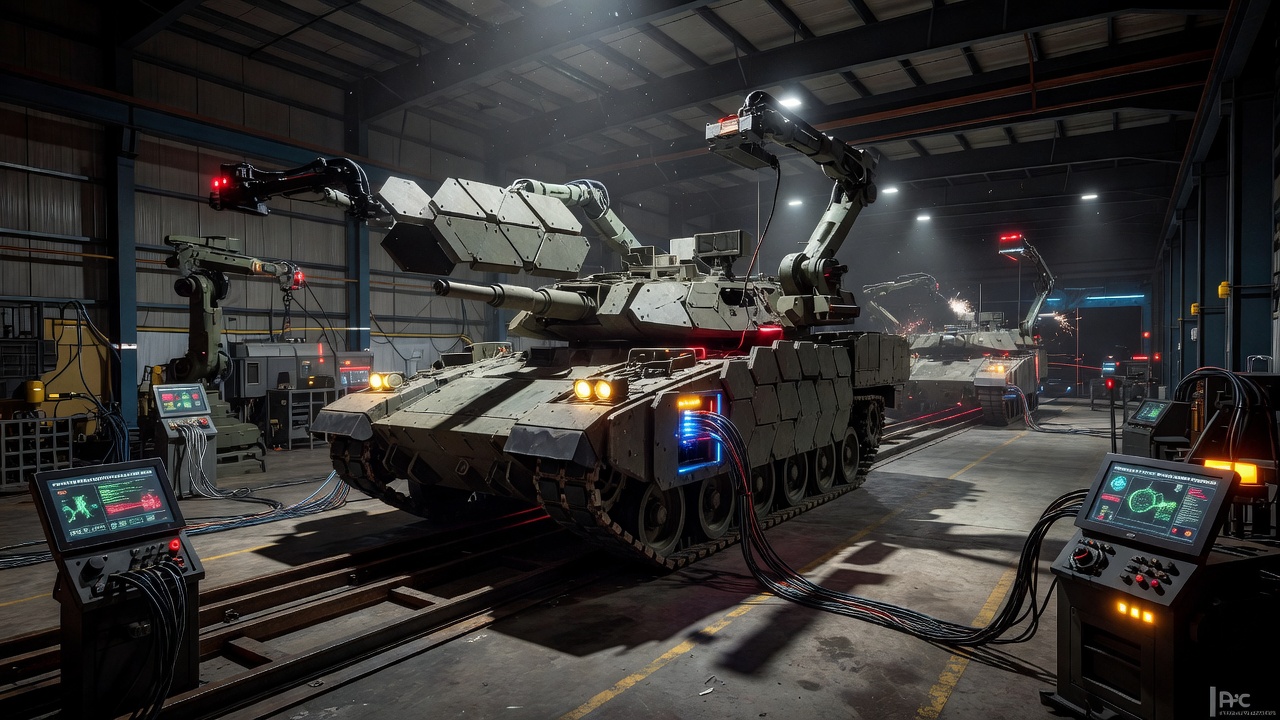
The U.S. Army has started installing a missile-intercepting defense system on its Bradley Fighting Vehicles, a shift that reflects hard lessons from recent conflicts about how vulnerable armored vehicles have become to shoulder-fired weapons and small drones. The 1st Cavalry Division, based at Fort Hood, Texas, is the first unit to receive the upgraded M2A4E1 Bradley, which carries Elbit Systems' Iron Fist active protection system as standard equipment.
The rollout follows a $228 million contract awarded to Elbit in January, building on an earlier $37 million order placed in 2024. For readers unfamiliar with how these interception systems actually work, a plain-English overview of active protection technology helps clarify why militaries are investing so heavily in defenses that operate in fractions of a second. Iron Fist uses radar and infrared sensors mounted around the turret to detect incoming projectiles, then fires an explosive interceptor designed to destroy the threat before it reaches the vehicle's armor. a plain-English overview
Why Armored Vehicles Need a New Layer of Defense
Tanks and infantry fighting vehicles have traditionally relied on steel and composite armor to survive battlefield strikes. That approach has eroded as anti-tank guided missiles, rocket-propelled grenades and inexpensive drones carrying explosive payloads have proliferated among state militaries and non-state groups alike. The war in Ukraine has made the problem impossible to ignore: footage of destroyed armored columns, hit by missiles or drone-dropped munitions, has circulated widely and pushed militaries worldwide to reconsider how they protect crews.
Active protection systems represent a different philosophy from passive armor. Rather than absorbing an impact, they aim to stop the threat before it connects. Iron Fist's interceptors use a combustible casing meant to limit fragmentation that could injure nearby soldiers, though Army officials acknowledge this does not remove the risk entirely. The tradeoff is familiar in defense engineering: a system that stops a missile aimed at the vehicle must still manage the secondary effects of destroying that missile in close proximity to infantry.
A Contract Structure That Leaves Questions Open
Elbit's role in this program is narrower than it might appear. The Israeli company is supplying the protection system itself, not acting as the lead integrator for the broader Bradley modernization effort, which General Dynamics oversees. Revenue from the $228 million award will be recognized incrementally as systems are delivered and installed, though Elbit has not specified a timeline.
The Army has likewise been sparse with details. It has not said how many Bradleys at Fort Hood will receive the upgrade, when that initial fielding will conclude, or how quickly Iron Fist will spread to the rest of the Bradley fleet. The contract establishes a framework for continued installations, but the pace and scope of that expansion remain undefined publicly.
Beyond the Protection System
The M2A4E1 variant bundles Iron Fist with other improvements, including a higher-resolution thermal sight for the gunner and a redesigned environmental control unit meant to improve conditions for the crew and any infantry riding inside. Together, these changes signal an Army trying to extend the service life of a vehicle design that dates back decades while adapting it to threats its original engineers never anticipated. Whether Iron Fist becomes standard across the entire Bradley fleet, or remains limited to select units, will depend on funding decisions and operational assessments still to come.