
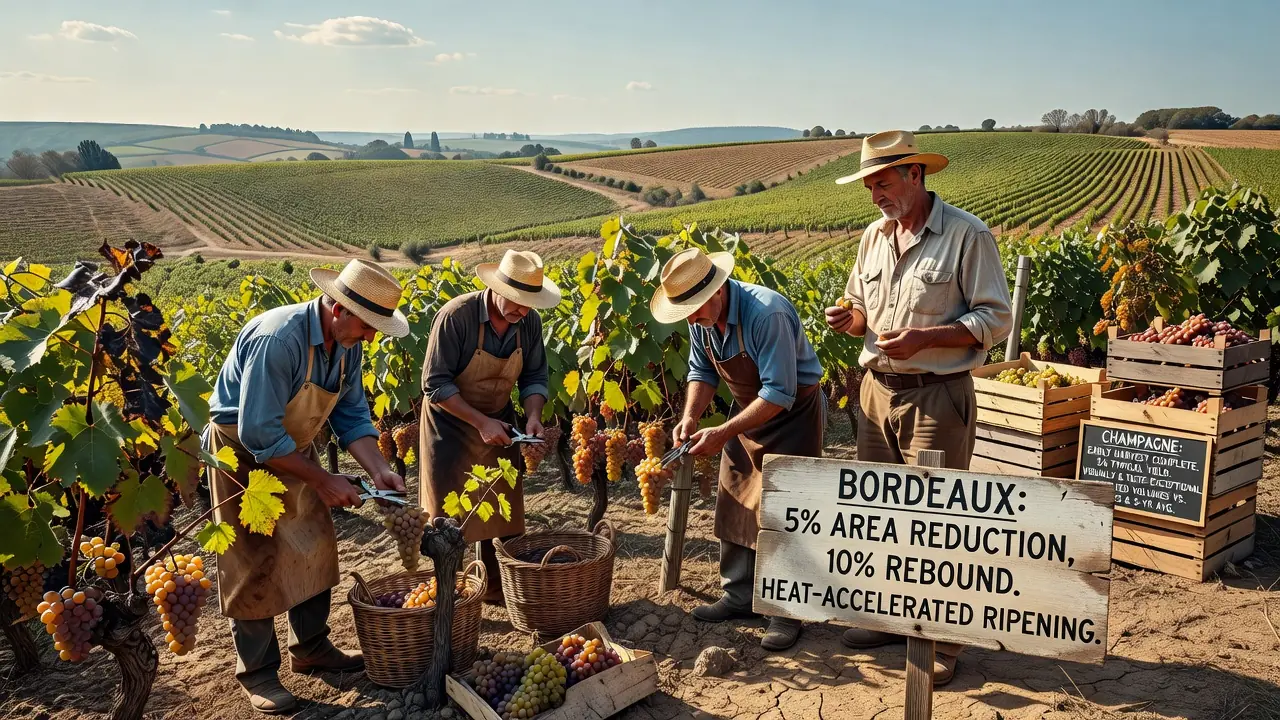
France's vineyards have produced one of their smallest harvests in decades, as repeated summer heatwaves and shrinking cultivated land combine to squeeze output across the country's wine regions. The agriculture ministry's estimates, published on Wednesday, put the total harvest at roughly 35m hectolitres - down 2% on an already weak 2025 and 14% below the five-year average. The International Organisation of Vine and Wine has noted that last year already marked France's lowest production since 1957, underscoring how persistent this decline has become.
Heat, rain and shrinking vineyards
The causes are layered. Sustained high temperatures accelerated ripening and stressed vines across much of the country, though recent rainfall offered some relief in certain areas. At the same time, the total area under cultivation fell by 1.9% over the past year, a reduction that compounds the effect of poor weather on overall volume. Climate pressure and land-use shifts are now reinforcing each other rather than operating in isolation.
A patchwork of winners and losers
The national figures mask sharp regional divergence. Bordeaux, despite cutting its cultivated area by 5%, is expected to see production rise by 10% compared with 2025 - though still 11% below its 2021-2025 average. The south-west region is on track for a similar rebound, roughly 12% higher, bringing it close to its recent historical norm.
Champagne tells a different story. Growers there were forced into an unusually early harvest, as extreme heat accelerated sugar buildup and natural alcohol formation in the grapes. For the first time, the Champagne harvest concluded in September, with volumes down by half relative to both last year and the five-year average. Producer Claude Mandois described gathering around three-quarters of a typical yield by volume, while noting the fruit's quality was, in his words, exceptional both visually and in taste.
Burgundy and Beaujolais fared worse still, with production projected 30% below their five-year average.
Adaptation under pressure
Jérôme Despey, chair of the wine advisory board at FranceAgriMer and a grower in Hérault, described the scale of variation this year as unlike anything he had previously seen. He pointed to how southern vineyards, having endured repeated heat extremes in recent years, have adapted their management practices - notably retaining more leaf cover to shield grapes from direct sun. Favourable May rainfall also helped southern regions outperform expectations.
Despite the volume losses, the ministry and industry bodies have stressed the harvest's overall quality, describing it as largely free from fungal infection and other moisture-related diseases that can plague wetter growing seasons.
Why this matters beyond the vineyard
A shrinking, more volatile harvest has consequences that extend past winemakers themselves. Reduced volumes can tighten supply for exporters, retailers and the hospitality sector, while regional disparities complicate pricing and sourcing decisions across the industry. The adaptation strategies now being tested in southern France - altered canopy management, closer attention to rainfall timing - may offer a template for other regions as climate variability becomes a recurring feature of European agriculture rather than an occasional disruption.