
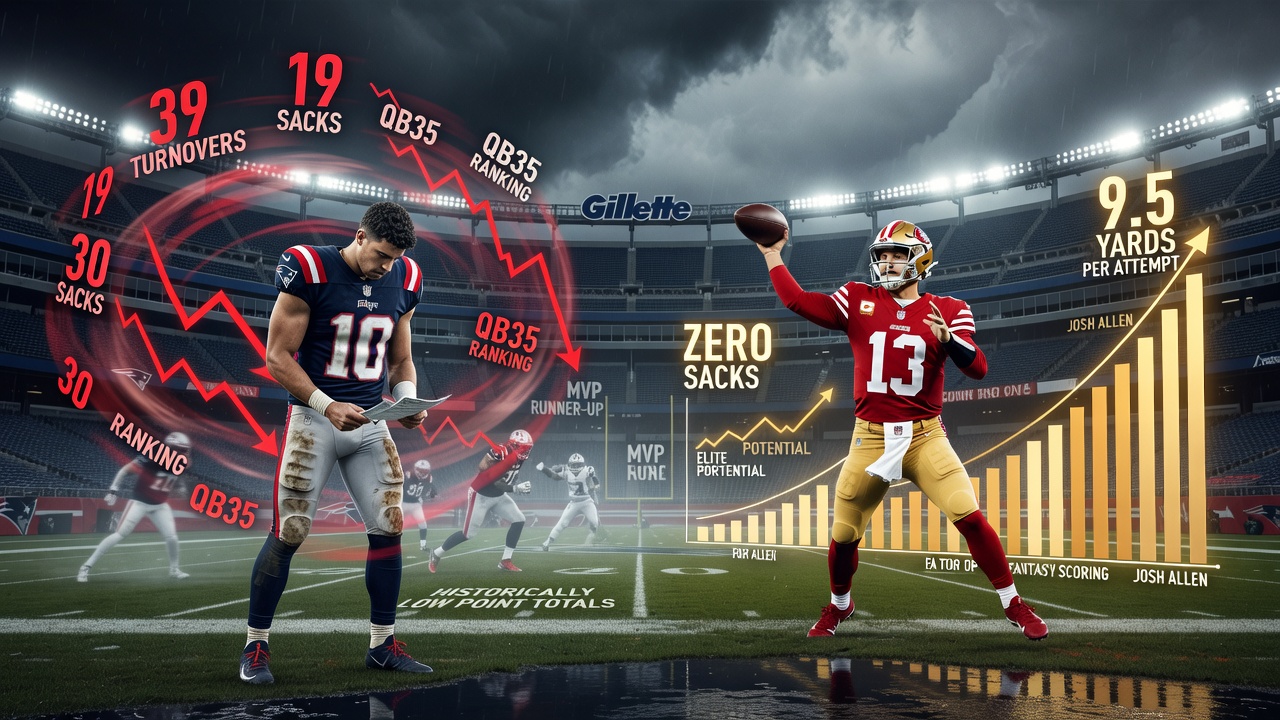
Three weeks into the season, the fantasy football quarterback landscape has inverted almost entirely. Drake Maye, last year's QB2 and a runner-up in MVP voting, now sits at QB35, buried under interceptions, sacks and a Patriots offense producing historically low point totals. Brock Purdy, meanwhile, trails only Josh Allen in fantasy scoring and is operating with an efficiency that borders on implausible given his reduced supporting cast.
What's Actually Broken in New England
Maye's drop-off isn't a single bad week - it's a seven-game pattern stretching back to last season's playoffs, during which he's been responsible for 19 turnovers and absorbed 30 sacks. The Patriots have managed just 29 points across 30 drives this season, the worst such mark since Zach Wilson's rookie stretch. An ongoing shoulder injury, the departure of A.J. Brown's level of target, and a more difficult early schedule all offer partial explanations. None of them fully account for the lowest adjusted net yards per attempt Maye has posted since 2021. For fantasy managers who invested premium draft capital, the calculus has shifted from patience to damage control.
Purdy's Efficiency Is Doing the Heavy Lifting
Purdy's 9.5 yards per attempt and zero sacks taken are not sustainable rates - some regression is inevitable as the sample grows. But the underlying formula hasn't changed: elite accuracy, enough mobility to extend plays, and Kyle Shanahan's scheme design doing much of the work before the ball even leaves his hand. That combination has made Purdy one of the clearer value plays at the position this year, even with fewer established weapons around him than in previous seasons.
Beyond the Quarterbacks: Usage Shifts Worth Tracking
Several other situations this week reflect how quickly role and opportunity can swing fantasy outcomes, separate from raw talent:
- Brock Bowers returned from a PCL injury to lead all tight ends in targets, operating as a de facto WR1 under new offensive coordinator Klint Kubiak - a workload shift that could make him a weekly top-10 option if health holds.
- Jeremiyah Love has taken over as a workhorse back, posting 26 of 32 available running back opportunities in a single game after clearing a high-ankle sprain.
- Jaxon Smith-Njigba is on a pace that would break multiple NFL receiving records, with his target share actually increasing despite a coaching change.
- Zay Flowers has posted extreme efficiency numbers in limited action, though a recurring hamstring issue remains the clear variable determining his season.
- Malik Nabers faces a murkier outlook after the Giants' trade for J.J. McCarthy, a quarterback whose track record with catchable targets has previously undercut elite receiving talent.
Why This Matters Beyond One Season
Fantasy football's growth as a business intersects directly with sports betting markets, DFS platforms and player-prop wagering, all of which price performance volatility like this in real time. Rapid swings - a former MVP candidate falling to replacement level, a backup-turned-starter outproducing established stars - are exactly the kind of variance that shapes weekly salary pricing on platforms like DraftKings, where JSN's valuation has already moved well past established veterans. For consumers engaging with these products, the lesson is less about any single player and more about the unpredictability baked into weekly fantasy and DFS formats: strong early-season form, in either direction, is not a guarantee of what follows.